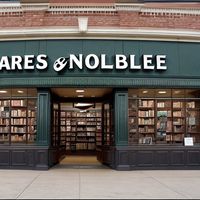
This month, a grand, multi-level establishment in Washington, D.C.'s Georgetown district welcomed back a previous tenant that had been absent for over ten years. In a move that seems more symbolic than commercially driven, Barnes & Noble, the largest book retailer in the United States, has reestablished its flagship store, which it had left in 2013. This reopening is part of an expansion initiative that includes over 60 new stores this year, an ambitious plan that seemed unlikely before James Daunt became CEO in 2018. Daunt views the return to the Georgetown location as a "vivid illustration of the ongoing resurgence of physical bookstores." Prior to Daunt's leadership, Barnes & Noble was on a trajectory similar to many struggling American retailers, with plummeting sales leading to numerous store closures as customers increasingly turned to online platforms like Amazon. However, the company revamped its business strategy, focusing on customer preferences over promotional campaigns and engaging with a community of readers on social media platforms.
Daunt differentiates himself from his predecessors by identifying himself as a bookseller rather than a retailer—a subtle yet significant difference that aligns with the company's "books first" philosophy. This approach meant empowering individual stores to decide which books to stock and feature, moving away from a uniform model. "When I took over Barnes & Noble, the bookstores themselves were not very impressive," Daunt stated. "A true bookstore needs to be curated, which is the essence of the core skills of a bookseller. The goal is to have titles that you believe will most engage your customers and to present them effectively."
Daunt's strategy was a risk. He was relying on the discretion of each store manager and abandoning the display space revenue paid by large publishers to promote new books。 But embracing the independent bookstore model has proven successful. Foot traffic data indicates that Barnes & Noble has seen a 7% increase in visits since 2019, according to location analytics firm Placer.ai. "We're now comfortable as a retailer," Daunt remarked. "In the past, we might have tried to control this process centrally. However, the sensible approach is to simply enjoy the autonomy of each individual store."
Daunt attributes part of Barnes & Noble's recent success to BookTok, a TikTok community that emerged in 2020 when influencers began showcasing new discoveries and sharing book recommendations. The hashtag #BookTok has garnered over 40 million posts and continues to grow in popularity, with its influence extending beyond the digital realm. Shannon DeVito, Barnes & Noble's head of books, notes that BookTok has not only rekindled a passion for reading but has also guided stores on inventory decisions. "Many stores capitalized on the BookTok trend by creating tables and various-sized displays because they had the flexibility, which is another advantage of stores truly determining their own direction," she said.
This trend is also driving customers to physical stores. Kendra Keeter-Gray, a BookTok content creator with over 100,000 followers, shared that she and her friends could spend anywhere from 30 minutes to a few hours in a Barnes & Noble, often in the BookTok section where they exchange recommendations and browse trending novels. "Visiting Barnes is almost like an adventure. I'd compare it to when I was young and my parents took me to an amusement park," she said.
Barnes & Noble has also leveraged BookTok's fan base by organizing community events, including midnight release parties and costume contests. "Stores are organizing events for their local areas, and we're seeing turnouts of hundreds of people for book launches," DeVito said. "This has really sparked a level of excitement around book releases that we haven't seen since the Harry Potter era."
More importantly, the revival of Barnes & Noble's stores confirms the company's belief in the enduring consumer demand for physical books. Like most bookstores, Barnes & Noble's primary revenue stream comes from the sale of physical books and limited editions exclusive to the retailer, often featuring special artwork or additional content. "There's always something that's supposed to signal the death of books, but what we've witnessed over the last four years is the complete opposite," DeVito said. "Our future outlook is very positive, which is not something I could have said a few years ago."

By Sophia Lewis/Nov 22, 2024
By William Miller/Nov 22, 2024
By Joshua Howard/Nov 21, 2024

By Victoria Gonzalez/Nov 21, 2024

By Michael Brown/Nov 21, 2024

By George Bailey/Nov 21, 2024

By Eric Ward/Nov 21, 2024

By Jessica Lee/Nov 21, 2024

By William Miller/Nov 21, 2024
By Emily Johnson/Nov 21, 2024

By Victoria Gonzalez/Nov 21, 2024

By Noah Bell/Nov 21, 2024

By Sarah Davis/Nov 19, 2024

By Samuel Cooper/Nov 19, 2024

By Jessica Lee/Nov 19, 2024

By Benjamin Evans/Nov 19, 2024

By Eric Ward/Nov 19, 2024
By Emily Johnson/Nov 19, 2024
By Victoria Gonzalez/Nov 19, 2024

By Sophia Lewis/Nov 19, 2024