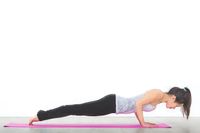
Fitness professionals widely regard planks as an exceptional exercise for fortifying the core muscles and other muscle groups, irrespective of one's age or fitness level. The plank comes in various forms, but its fundamental structure involves maintaining balance on your toes and forearms while keeping your body elevated from the ground.
Although the plank might seem challenging, especially for those not deeply involved in fitness, it can be tailored to suit different abilities, ranging from beginner-friendly to advanced variations. The origins of the plank are somewhat obscure, with some attributing its invention to Joseph Pilates, who developed the Pilates method in the early 20th century. What is undeniable is that planks have become a preferred core-strengthening exercise in recent years, surpassing traditional crunches and sit-ups. Unlike the latter, planks do not exert undue stress on the spine and hip flexors.
Benefits Beyond Spinal Considerations
The plank's popularity extends beyond its gentle impact on the spine and hip flexors. Dr. Claire Morrow, a physical therapist at Hinge Health, a digital musculoskeletal clinic, explains that planks engage numerous muscle groups simultaneously. "The plank can stimulate your postural muscles, shoulders, the back of the neck, elbows, triceps, hips, and quadriceps," she notes. "It's an efficient exercise in terms of the muscle activation it provides." Julie Logue, the director of programming operations for SilverSneakers, a fitness program designed for adults aged 65 and above, adds that planks are excellent for enhancing functional fitness. "Regular plank practice can improve posture and facilitate daily activities," she says. "They're also valuable as they rely on body weight, allowing you to perform a plank at any time and in any place."
Additional Advantages of Plank Exercises
Planks offer benefits that extend beyond strength, posture, and balance. For instance, a study published in the December 2021 issue of Healthcare found that planks can aid in combating urinary incontinence. Furthermore, a study in The Journal of Strength and Conditioning Research's June issue concluded that planking can enhance golf swings. For those new to planks, Dr. Morrow suggests starting in a standing position with hands on a wall or countertop, then stepping back until leaning into the surface. Hold this stance for 10 seconds and repeat four times. "The starting position is crucial," she emphasizes. "Once you can maintain a wall plank for 30 seconds, you can increase the duration or change your position."
Progressing with Planks
Progressing might involve moving to a lower surface, such as the edge of a couch or a step, or transitioning to the floor. From there, one can perform a plank on knees and hands or knees and forearms, which is beneficial for those with wrist issues, as Logue suggests. She also recommends the bird dog exercise as an introductory activity: "Get on all fours, then extend one arm and the opposite leg. This prepares you for body-weight exercises and helps build core strength." Regardless of the starting position, proper form is essential when planking. Both Morrow and Logue advise tightening the core muscles, glutes, and quadriceps, ensuring that the shoulders and hips are not sagging and the buttocks are not raised excessively. Consulting a physical therapist or personal trainer is recommended if unsure about form.
Breathing and Variations
Logue also stresses the importance of breathing during planks, noting that holding one's breath can be hazardous. "Remember to focus on your breathing," she advises. Once comfortable with floor planks, consider incorporating variations. Side planks, for example, involve balancing on one forearm with feet stacked and the body in a sideward position. "Side planks target more of your side body and hip abductors, which are crucial for balance," Morrow explains. Other variations include mountain climbers, which start in a push-up position and involve a marching motion, and cross-body mountain climbers, which alternate the knee-to-elbow movement. Climbing planks involve alternating between forearms and hands, simulating a climbing motion.
Creating a Balanced Plank Routine
Logue suggests creating a plank regimen that includes traditional planking and several variations to prevent muscle overuse and promote a balanced physique. The key is to start planking gradually and easily. "There's no age or fitness level at which you're too old or out of shape to try an exercise program, whether it's planking, walking, or squatting," Morrow says. "There's always an entry point; yours might just be different from someone else's."
Encouraging a Healthy Routine
For those looking to ease into a healthy routine, consider signing up for the Fitness, But Better newsletter series, a seven-part guide backed by experts. Melanie Radzicki McManus, a freelance writer specializing in hiking, travel, and fitness, provides this comprehensive guide to help anyone, regardless of their starting point, to incorporate planks into their fitness journey.

By Emma Thompson/Dec 17, 2024

By Olivia Reed/Dec 17, 2024
By Emma Thompson/Dec 17, 2024

By Lily Simpson/Dec 17, 2024

By Benjamin Evans/Dec 17, 2024

By Joshua Howard/Dec 17, 2024

By Megan Clark/Dec 17, 2024

By William Miller/Dec 17, 2024

By Lily Simpson/Dec 17, 2024

By Benjamin Evans/Dec 17, 2024

By Daniel Scott/Dec 13, 2024

By John Smith/Dec 13, 2024

By Lily Simpson/Dec 13, 2024

By Victoria Gonzalez/Dec 13, 2024

By Emily Johnson/Dec 13, 2024

By George Bailey/Dec 10, 2024

By Emily Johnson/Dec 10, 2024

By Samuel Cooper/Dec 10, 2024

By Olivia Reed/Dec 10, 2024

By Michael Brown/Dec 10, 2024